
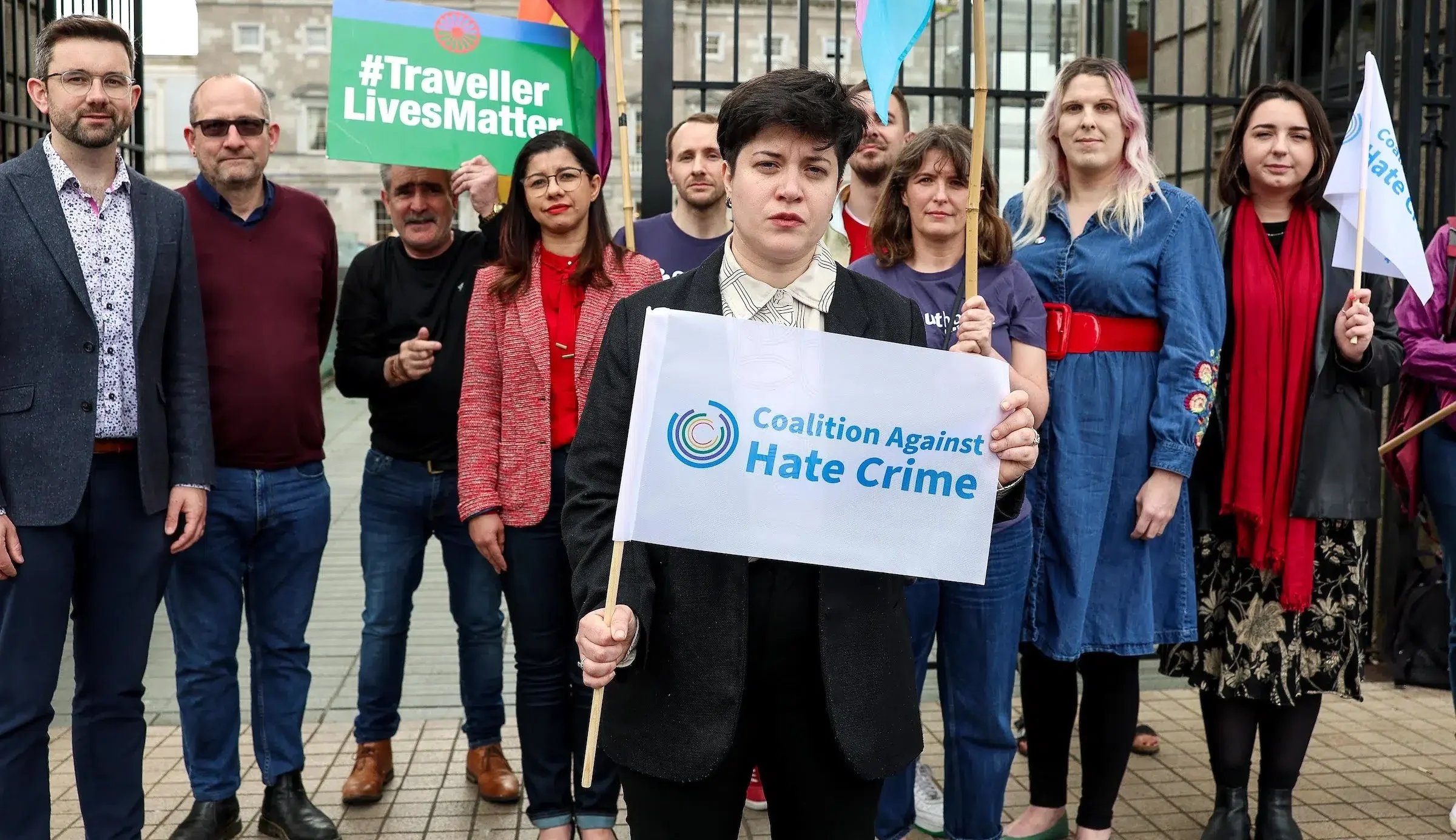
Nasc is a co-chair of the Coalition Against Hate Crime, a broad civil society alliance working to strengthen Ireland’s response to hate crime and hate-motivated incidents.
Hate crime has a direct and disproportionate impact on migrant, refugee and minority communities. It undermines safety, social cohesion and equal participation in public life. Our engagement in this area reflects our core mandate to advance migrant and refugee rights and to challenge discrimination in all its forms.
What Is Hate Crime?
Hate crime refers to criminal offences that are motivated, in whole or in part, by prejudice against a person’s protected characteristic. These characteristics may include race, nationality, ethnicity, religion, sexual orientation, gender identity, disability or other protected grounds under equality law.
Hate crimes are distinct from other criminal offences because they are targeted at an individual not only for who they are, but for what they are perceived to represent. The impact extends beyond the immediate victim and affects entire communities.
In addition to hate crime, hate-motivated incidents that do not meet the threshold of a criminal offence can still cause significant harm and contribute to fear and marginalisation.
The Coalition Against Hate Crime
The Coalition Against Hate Crime brings together civil society organisations representing communities affected by racism, antisemitism, Islamophobia, anti-Traveller racism, anti-Roma racism, anti-LGBTQ+ hate and other forms of targeted hostility.
The Coalition advocates for:
• Effective hate crime legislation
• Clear recognition of bias motivation in criminal law
• Improved data collection and reporting mechanisms
• Victim-centred supports
• Strong safeguards against extremist and hate-driven narratives
Legislative Reform in Ireland
As co-chair of the Coalition, Nasc contributes to policy engagement, public advocacy and legislative scrutiny. We work alongside partner organisations to ensure that Ireland’s legal framework responds appropriately to hate-motivated violence and hostility.
For many years, Ireland’s legislative framework. relied on the Prohibition of Incitement to Hatred Act 1989. That Act makes it an offence to publish, distribute, broadcast or use words, images or sounds that are threatening, abusive or insulting and are intended or likely to stir up hatred against a group of people on account of characteristics such as race, nationality, religion, ethnicity, membership of the Traveller community or sexual orientation. This law continues in force and remains the primary statute addressing hate speech and incitement to hatred in Ireland. While the 1989 Act criminalised hate speech, prosecutions under it were historically rare, and it was widely regarded as outdated and limited in scope.
In response to civil society advocacy and public consultation, the Oireachtas progressed a new legislative framework. The Criminal Justice (Hate Offences) Act 2024 recognises hate crime as a distinct category of criminal conduct for the first time in Irish law. It amends existing offences such as assault, criminal damage and public order offences so that, where an offence is motivated by hatred against a protected characteristic, it is treated as aggravated with increased maximum penalties. Under this Act, which came into force at the end of 2024, prosecutors can bring proceedings where aggravation by hatred is demonstrated.
Attempts to combine hate crime provisions with new incitement to hatred or hate speech offences in the same Bill were abandoned during parliamentary consideration. Sections of earlier Bills that would have updated or replaced the 1989 Act’s hate speech provisions were removed. As a result, incitement to hatred and hate speech continue to be governed by the 1989 Act rather than by a modernised statutory offence.
Nasc and the Coalition Against Hate Crime continue to advocate for a clear, comprehensive and rights-compliant legislative framework that addresses both hate speech and hate crime, protects victims effectively and aligns with international human rights standards.


